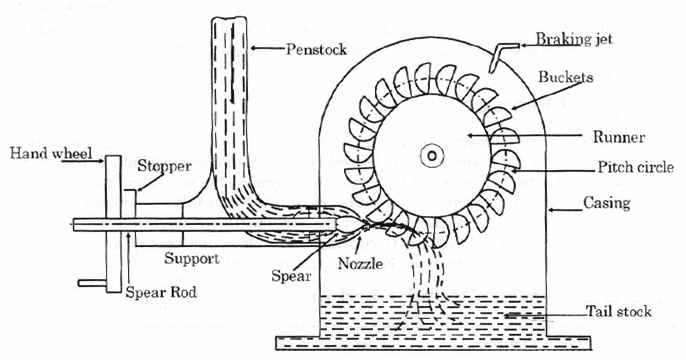
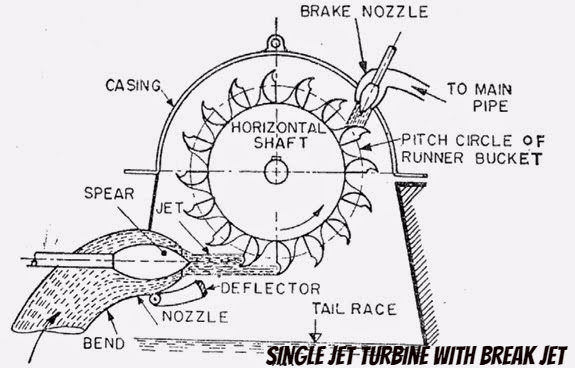
HYDRAULIC TURBINES
A turbine is a type of engine that can extract energy from a fluid, such as water, steam, air, or combustion gases. It has a series of blades, typically made of steel but sometimes ceramic, that can withstand higher temperatures. The fluid goes in one end, pushing the blades and causing them to spin, then gets ejected out the other end. The fluid leaves the engine with less energy than it had going in — a portion of the difference is captured by the turbine.
REACTION TURBINES
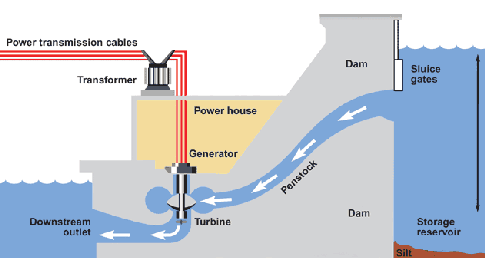
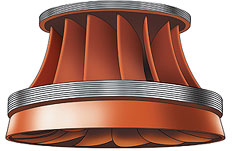
Reaction Turbine: The principal feature of a reaction turbine that distinguishes it from an impulse turbine is that only a part of the total head available at the inlet to the turbine is converted to velocity head, before the runner is reached. Also in the reaction turbines the working fluid, instead of engaging only one or two blades, completely fills the passages in the runner. The pressure or static head of the fluid changes gradually as it passes through the runner along with the change in its kinetic energy based on absolute velocity due to the impulse action between the fluid and the runner. Therefore the cross-sectional area of flow through the passages of the fluid. A reaction turbine is usually well suited for low heads. A radial flow hydraulic turbine of reaction type was first developed by an American Engineer, James B. Francis (1815-92) and is named after him as the Francis turbine. The schematic diagram of a Francis turbine is shown
FRANCIS TURBINE
FRANCIS TURBINE
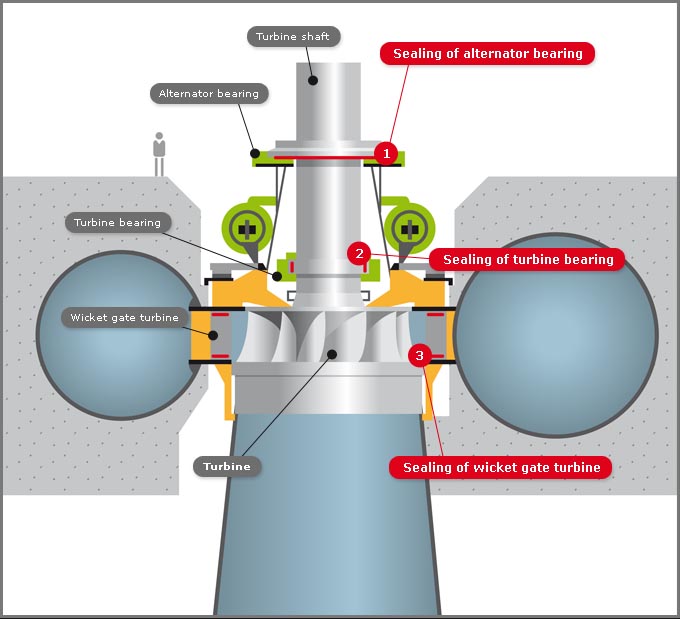
The Francis turbine is a type of water turbine that was developed by James B. Francis in Lowell, Massachusetts.[1] It is an inward-flow reaction turbine that combines radial and axial flow concepts. Francis turbines are the most common water turbine in use today. They operate in a water head from 40 to 600 m (130 to 2,000 ft) and are primarily used for electrical power production. The electric generators which most often use this type of turbine have a power output which generally ranges just a few kilowatts up to 800 MW, though mini-hydro installations may be lower. Penstock (input pipes) diameters are between 3 and 33 feet (0.91 and 10.06 metres). The speed range of the turbine is from 75 to 1000 rpm. Wicket gates around the outside of the turbine's rotating runner control the rate of water flow through the turbine for different power production rates. Francis turbines are almost always mounted with the shaft vertical to keep water away from the attached generator and to facilitate installation and maintenance access to it and the turbine.
KAPLAN TURBINE
KAPLAN TURBINE
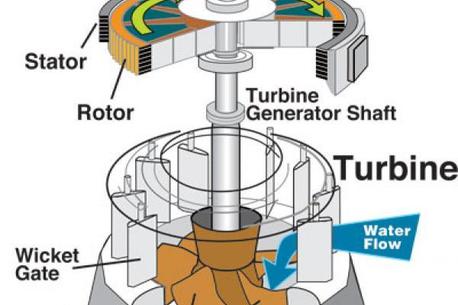
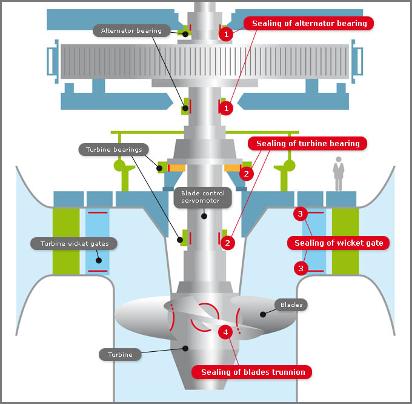
The Kaplan turbine is a propeller-type water turbine which has adjustable blades. It was developed in 1913 by the Austrian professorViktor Kaplan, who combined automatically adjusted propeller blades with automatically adjusted wicket gates to achieve efficiency over a wide range of flow and water level. The Kaplan turbine was an evolution of the Francis turbine. Its invention allowed efficient power production in low-head applications that was not possible with Francis turbines. The head ranges from 10–70 meters and the output from 5 to 200 MW. Runner diameters are between 2 and 11 meters. The range of the turbine rotation is from 79 to 429 rpm. The Kaplan turbine installation believed to generate the most power from its nominal head of 34.65m is as of 2013 the Tocoma Power Plant (Venezuela) Kaplan turbine generating 235MW with each of ten 4.8m diameter runners.[1] Kaplan turbines are now widely used throughout the world in high-flow, low-head power production.
PELTON WHEEL IMPULSE TURBINE
PELTON WHEELIMPULSE TURBINE
An Impulse turbine, from the Greek τύρβη, tyrbē, ("turbulence") is a rotary mechanical device that extracts energy from a fluid flow and converts it into useful work. A turbine is a turbomachine with at least one moving part called a rotor assembly, which is a shaft or drum with blades attached. Moving fluid acts on the blades so that they move and impart rotational energy to the rotor. Early turbine examples are windmills and waterwheels. Gas, steam, and water turbines have a casing around the blades that contains and controls the working fluid. Credit for invention of the steam turbine is given both to the British engineer Sir Charles Parsons (1854–1931), for invention of the reaction turbine and to Swedish engineer Gustaf de Laval (1845–1913), for invention of the impulse turbine. Modern steam turbines frequently employ both reaction and impulse in the same unit, typically varying the degree of reaction and impulse from the blade root to its periphery.